The step-by-step course for English speakers buying a home or second home in France — built on verified 2026 French law, not advice that expired years ago.
Lifetime access · 5 calculators included · 30-day guarantee
Shutters open onto a quiet street. Coffee at the market on Saturday. A stone house in the southwest, an apartment near the sea, a bolt-hole in a village you fell for on holiday. The dream is real, and France still sells more than 950,000 properties a year to people who decide to make it happen.
Here's the problem nobody puts on the brochure: almost every English-language guide to buying in France is dangerously out of date. Most were written between 2004 and 2010. They predate the rules that now decide whether your purchase is a joy or an expensive trap — the loi Le Meur, the 2025 and 2026 finance laws, the DPE rental bans, the social-charge changes, the post-Brexit visa reality.
If you follow that old advice, you can lose real money and real time on mistakes that were entirely avoidable. This course exists so you don't.
These aren't hypotheticals. Each one is a current rule that contradicts what you'll read in most older books and blogs.
❌ "Buy a property and you get residency." France has never run a real-estate golden visa, and buying still grants no right to stay and no visa. As a non-EU citizen — including UK passport holders since 1 January 2021 — you get 90 days in any rolling 180 in the Schengen area, full stop. Staying longer means a proper long-stay visa (the VLS-TS "visiteur" route), with its own income and health-insurance bar.
❌ "Notaire fees are about 7% everywhere." They're not flat anymore. Since the 2025 finance law, départements may add up to +0.5 points to transfer duty, and as of 1 January 2026 the higher rate applies in 87 of 101 départements. Frais de notaire are now geographic — on resale (ancien) you're looking at roughly 7–8%, but the exact number depends on which département you buy in, and new-build (neuf/VEFA) is a completely different ~2–3%.
⚠ Note: the ~7–8% ancien figure is an illustrative order-of-magnitude range, to be department- and date-stamped — not a single quoted tariff.
❌ "A cheap old house is a bargain." Maybe — or maybe it's a passoire thermique you legally cannot rent out. Since 1 January 2025, a DPE class-G home is "indecent" and cannot be let on a new or renewed lease (class F follows in 2028, class E in 2034). It can still be sold and lived in — but if you ever hoped to let it part-year to offset costs, that plan may be dead until you renovate.
❌ "Taxe d'habitation is gone." It's gone on primary residences. It is still due on second homes — and in high-demand "zones tendues," communes can add a surtaxe on top. A holiday home carries annual costs that a forever-home calculator never shows you.
These four traps share one thing: the guide that misses them sounds completely confident. Confidence is not currency. This course is built on facts verified as of 2026, each one dated and sourced.
Most "buying in France" content is a travel story with a property agent's logo on it. This is a safe, current, step-by-step system that takes you from "I think I want a place in France" all the way to keys in hand — and tells you the truth at every step, including the parts agents and sellers would rather you didn't ask about.
It is the only kept-current, calculator-driven course built on verified 2026 French law. We pin every France-specific number to a dated facts pack, isolate the fastest-changing rules into clear lessons, and teach you a simple "verify before you sign" habit so you act on what's true now — not what was true in 2009.
Education, not advice. This course teaches you how France's rules work so you can ask the right questions and make informed decisions. It is not legal, tax, or financial advice, and it does not replace your notaire, a French fiscaliste, or a licensed broker. We tell you exactly when to bring in a professional — and what to ask them.
A focused path through the modules and tools every home and second-home buyer needs. (These are drawn from The French Property Playbook's shared core and Lifestyle track.)
Set a clear objective and a measurable "buy box," figure out where you stand (resident vs non-resident, EU vs non-EU — because it changes everything downstream), and get the full briefing on what changed in 2025–2026 so you can spot bad advice on sight.
You build: your Goal Statement, your Buy Box, a Status Self-Assessment, and a "What Changed" cheat-sheet you keep for the whole journey.
The whole transaction on one page: offre d'achat → compromis → the 10-day SRU cooling-off → the condition suspensive de prêt → diagnostics → the acte authentique. You'll understand the notaire's real role (a public officer — not your lawyer), your three legal "escape hatches," and exactly what that ~7–8% acquisition cost is actually made of.
You'll learn: why a class-G DPE blocks letting but never blocks the sale, how the +0.5-point DMTO changes your bill by département, and which mandatory diagnostics must be on the table before you sign.
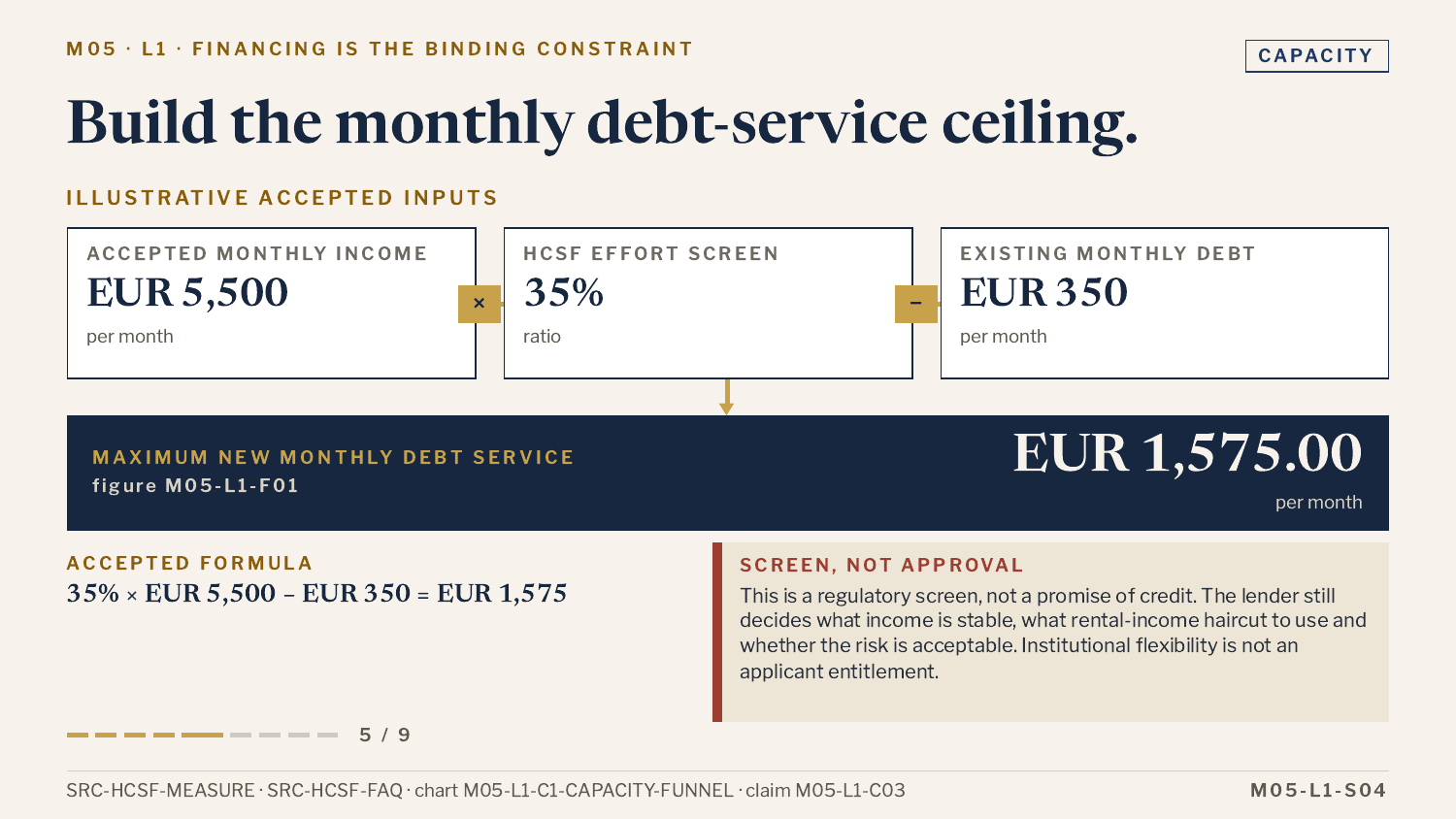
French mortgages are long-term fixed-rate — not US/UK adjustable products. You'll model your borrowing capacity under the binding HCSF rules (max 35% taux d'effort, insurance included; max 25-year term), and understand the harder reality for foreign buyers: EU/EEA buyers can reach ~80–85% LTV, but non-EU buyers (US/UK) commonly see 50–70% LTV and need more cash down. You'll also learn to cut your insurance cost using loi Lemoine (switch insurer anytime, free).
⚠ Average rates as of June 2026: ~3.20% (15-yr) / 3.37% (20-yr) / 3.48% (25-yr) — a moving target you'll learn to re-check before you act.
The four moments France taxes a property — at purchase, on rental income, every year you hold it, and at exit — and which ones hit a pure second-home owner versus a buyer who lets. Plain-English coverage of the regimes, the annual holding costs (taxe foncière, taxe d'habitation on second homes, IFI awareness above €1.3M), and the foreign-owner basics (situs taxation, US FBAR/Form 8938, UK Self Assessment) so nothing later catches you cold.
The myth that sells houses, dismantled: property is not a visa. You'll apply the 90/180 Schengen rule to your own travel pattern, decode the long-stay routes (VLS-T, the VLS-TS "visiteur" permit, and why the Talent Passport is about business investment, not real estate), and understand the difference between the right to stay and becoming tax-resident. Includes the practical relocation checklist — the visiteur-visa income bar (roughly SMIC-level passive income, ~€17,000/yr for a single applicant), private health insurance, banking, and ANEF validation.
Match your life to the right place using the 2026 "two-speed market" — not a postcard. Read a DPE and an audit énergétique correctly, place a target on the ban trajectory (G banned to let since 2025, F from 2028, E from 2034), scope a realistic renovation budget with contingency, and compute the true total cost of ownership — acquisition, the rising taxe foncière, taxe d'habitation + any second-home surtaxe, copropriété charges, insurance, energy, and maintenance — right down to the cost per night of personal use.
Even if you only want a home, life changes — and the day you let it, French tenant-protective law applies in full. You'll run the DPE "can I even let this?" gate first, then choose the right lease (bail nu vs meublé), set a compliant deposit, apply the correct notice rules, and check whether you're inside a rent-control (encadrement) zone — including the live question of whether that regime survives its scheduled 23 November 2026 expiry.
⚠ Moving target: we track whether encadrement is renewed, extended, or lapses — and update the lesson when it resolves.
This isn't a video library you half-watch. Every key decision has a working tool (delivered as ready-to-use spreadsheets).
| Tool | What it does for you |
|---|---|
| Orientation Pack | Locks your goal, buy box, and resident/non-resident status so every later step is run against your situation. |
| French Purchase Timeline & True-Cost Calculator | Enter price, ancien vs neuf/VEFA, your département (with or without the +0.5pt), and primo-accédant status → get your real DMTO, émoluments, and total cost, plus a step-by-step timeline flagging what's reversible and what isn't. |
| Visa & Residency Route Selector | Answer a few questions about nationality, stay pattern, work intention, and income → get routed to "no visa needed / 90-180 only / VLS-T / VLS-TS visiteur / Talent Passport," with the income and insurance bar for each. |
| Second-Home Planner | A true-cost-of-ownership model — acquisition through annual carrying costs — that shows your cost per night of use and a break-even-if-you-let figure. |
| Letting Compliance Checker | The "can I legally let this?" gate: DPE class + lease-start date → CAN LET / CANNOT LET / LET UNTIL [date], plus lease-type, deposit, and rent-cap checks. |
Get the course & all 5 calculators
Prefer to try one first? Run the free buying-costs calculator — no charge, email-gated.
Every France-specific figure in this course is dated and sourced to a verified facts pack. The fastest-changing items are flagged as moving targets, so you always know what to re-check before you act.
The myth: "frais de notaire are about 7%, flat, everywhere." Wrong twice over — it's geographic, far lower on new-build, and ~80% of it is transfer TAX, not the notaire's fee. The old guides quote a single number; this course teaches you the real, department-specific math.
For buyers who want the numbers kept current for them continuously, there's an optional "French Property Current" membership (€29/mo or €300/yr — price pending validation).
No testimonials we couldn't verify, and no invented statistics — just the discipline the course is built on.
Credibility here comes from the verified, dated, sourced facts layer — not a presenter persona or a wall of unverifiable reviews.
"Buy Your French Home" — complete self-paced course + all 5 calculators. One-time payment. No subscription. Yours to keep.
Price point is an estimate pending market validation.
One-time payment · No subscription · Yours to keep
Want to let or invest for yield? If your plan is really about rental income, returns, or building a portfolio, this lifestyle course is the wrong tool — and we'll tell you so. You'll get a clear upgrade path to our investor flagship, "Build a French Portfolio" (€1,500 — price pending validation), which adds deal underwriting, LMNP/SCI tax structuring, scaling, short-term-rental compliance under loi Le Meur, and the full kept-current toolset. Many lifestyle buyers start here, then upgrade the moment they decide to let. (Upgrade credit may apply — pending validation.)
Work through the first modules, build your Buy Box and run the True-Cost Calculator on a real listing, and if the course hasn't given you a clearer, safer path to buying in France than anything you've read elsewhere, email us within 30 days for a full refund.
Refund window and terms pending final validation.
We can offer this because the value shows up fast: the first time the calculator reveals the real cost of a property in your target département, or the visa selector tells you the truth about your stay, you'll know more than most buyers learn the expensive way.
No. It's education. We teach how France's rules work — current as of 2026 — so you can make informed decisions and ask your notaire, fiscaliste, or broker the right questions. We're explicit about when to bring in a licensed professional.
Especially for you. Module 1 establishes your status up front, and the financing, visa, and tax modules cover the non-EU reality directly — the tougher 50–70% LTV mortgage lane, the 90/180 rule, the long-stay visa routes, and home-country reporting (US FBAR/8938, UK Self Assessment).
That's exactly why every France-specific figure here is dated and sourced, and why we teach a "verify before you sign" habit. The fastest-changing items (mortgage rates, the quarterly usury ceiling, the rent-control expiry) are flagged as moving targets so you always know what to re-check. For buyers who want the numbers kept current for them continuously, there's an optional "French Property Current" membership (€29/mo or €300/yr — price pending validation).
You can skip it for now, but we include it because plans change, and the day you decide to let — even part-year — French law applies in full and the DPE ban decides whether you legally can. It's there when you need it.
Free content is usually a travel story, a sales funnel, or both — and most of it is built on pre-2025 rules. This is a structured system with working calculators and verified, dated facts, designed to protect your money, not sell you a specific house.
No. The course is in English and translates the key French terms (compromis, condition suspensive, frais de notaire, DPE, taxe d'habitation, and the rest) so you can hold your own with professionals on the ground.
Self-paced video plus downloadable workbooks and spreadsheet tools. A motivated buyer can work through the core in a few focused sessions; most people pace it alongside an active search.
Learn the system that's actually true in 2026 — then go get your French home.
Lifetime access · 5 calculators included · 30-day guarantee (price & terms pending validation)