Built on verified 2026 French law — not advice that expired three reforms ago. Analyze, finance, structure, let, and exit French real estate correctly, and walk out with a written go/no-go dossier for your situation instead of someone else's dated guesswork.
For international investors — resident & non-resident, EU & non-EU. Education, not financial, tax, or legal advice.
Verified rules · as of June 2026
Open almost any English-language guide, blog, or video on "investing in French property." Read the publication date. Then read what it tells you about tax.
Most of it was written — or last meaningfully updated — before the rules that now decide whether your deal makes or loses money even existed. The advice sounds confident. It's often the top result. And on the points that matter most, it is simply wrong now.
For furnished-let resales completed from 15 February 2025, the depreciation (amortissement) you deducted during ownership is added back into your taxable capital gain on exit (LF 2025 art. 84, CGI 150 VB III). Pre-2025 depreciation is recaptured. Every guide that still says "LMNP lets you depreciate and never pay it back" is describing a world that ended in February 2025.
Since 1 January 2025, a DPE class-G dwelling is "indecent" and unlettable on any new or renewed lease (décret 2023-796; service-public A17975). Class F follows in 2028, class E in 2034. A "high-yield" listing that's a passoire thermique has a rental yield of zero until you renovate.
Loi Le Meur (n° 2024-1039) cut non-classé furnished tourist lets from 50%/€77,700 to 30% / €15,000, and classé from 71%/€188,700 to 50% / €77,700. A 13-digit national registration number is now mandatory, with a téléservice declaration deadline of 20 May 2026.
Under LFSS 2026 (LOI n° 2025-1403), furnished-letting BIC for LMNP (non-professional) landlords rose to 18.6% — but revenus fonciers and real-estate capital gains stay at 17.2% (LMP sits under SSI cotisations instead). Most online "calculators" apply one flat rate to everything. That single error mis-prices every furnished deal.
The 2025 DMTO reform (LF 2025 art. 116) let départements lift departmental transfer duty from 4.50% to 5.00% — at the 5.00% rate in 88 of 101 départements in 2026 (impots.gouv.fr DMTO table). Acquisition cost is now geographic.
Any guide still recommending a Pinel tax break is recommending a scheme that no longer exists.
This is the wedge nobody else is built on. The English-language field is thin — a handful of consultants and translated agency blogs — and almost none of it is maintained against current French law. Build a French Portfolio is the only course that pins every figure to a dated, citation-backed facts layer and hands you working calculators that produce the answer for your income, residency, regime, and region.
French property rewards the well-advised and punishes the confidently-misinformed. Three mistakes account for most of the damage.
You buy furnished, depreciate the building for years, and enjoy near-tax-free rental income. Then you sell — and discover that since 15 February 2025 all that "admis en déduction" depreciation is clawed back into the gain, taxed at 19% IR + 17.2% social charges plus the progressive 2%–6% surtaxe on net gains above €50,000 (CGI 1609 nonies G). A strategy that looked brilliant on a 2024 blog becomes a tax bill you never reserved for.
The course teaches you to quantify this before you sign — including the subtlety that amortissements différés (never actually deducted) are not recaptured, and that managed student/senior residences (CCH L.631-12/13) are excluded.
You buy a "cheap, high-yield" unit. It's class G. As of 1 January 2025 you legally cannot let it on a new lease. Your modelled 9% gross becomes 0% until you fund a renovation to lift it out of the banned class — capex the listing never mentioned.
The course makes the DPE gate the first screen on every deal, and shows you the €21,400/yr enhanced déficit-foncier energy cap (class lifted by 31 Dec 2027) that can help finance the fix if you let unfurnished under réel.
Regime (micro vs réel) and vehicle (own name vs SCI à l'IR vs SCI à l'IS) are at-purchase, hard-to-reverse decisions made at the notaire's desk. Pick SCI à l'IS for the headline 15% rate without modelling the exit, and the gain is taxed on net book value with no holding-period abatement — the opposite of what you wanted. Default a furnished portfolio into an SCI à l'IR and furnished letting forces it into IS anyway.
Get this wrong and you can't simply switch later: the switch is itself a taxable event.
Generic advice can't catch these, because the right answer depends on whether you're resident or non-resident, EU or non-EU, furnished or unfurnished, holding or exiting, and which département you buy in. That's exactly what a calculator-driven, status-aware system is for.
Build a French Portfolio is the investor flagship of The French Property Playbook — a complete, self-paced 14-module course plus 14 working calculators (Excel tools) and a kept-current 2026 facts layer, sold as one system.
It's built on a simple structure. A shared analytical-and-process core teaches every investor the non-negotiables — the math, the real market numbers, the notaire-driven purchase, financing, and the money/tax foundations. Then the investor track goes deep on sourcing, underwriting, structuring, and scaling. Everything reconverges on what every owner shares: compliant letting, short-term-rental rules, and the exit.
Every module ships fill-in deliverables; every tool is a working .xlsx you keep.
Set an explicit objective and Buy Box, fix your status fork (resident/non-resident, EU/non-EU), and get the full "currency briefing" on what changed — Pinel ending, the 15-Feb-2025 LMNP reform, the class-G ban, loi Le Meur, the LFSS-2026 18.6% split, DMTO geography, and the truth that buying grants no right to stay and no golden visa exists.
Tool: Orientation Pack — Goal Statement, Buy Box, Status Self-Assessment, "What Changed" cheat-sheet, Moving-Targets Watchlist.
Master the durable metrics — gross/net yield, NOI, cap rate, cash-on-cash, DSCR — and build the reusable spine model. Learn why a French "rendement" headline lies (national gross ≈ 4.78%, but net is typically 25–35% lower) and read DSCR against the HCSF 35% ceiling.
Tool: The French Property Deal Model — the course's reusable spine, with pre-labelled plug-in cells for every later module.
Weight the four kinds of market evidence correctly (INSEE index, Notaires avant-contrats, MeilleursAgents estimates, Meilleurtaux yield studies) and read the 2026 two-speed recovery — Nantes, Lyon and rural up; Nice, Bordeaux, Strasbourg down. Screen for the yield-killers listings never show.
Tool: Market Screen Scorecard — price/m² + yield + trend + encadrement + DPE-stock + DMTO %, each source- and date-stamped.
Walk the legal transaction from offre to acte authentique, use your three escape hatches (10-day SRU cooling-off, condition suspensive de prêt, deposit refund), and decode the ~7–8% ancien vs ~2–3% neuf/VEFA cost stack — with the DMTO +0.5pt and the émoluments brackets (3.870% / 1.596% / 1.064% / 0.799%, renewed by arrêté 25 Feb 2026).
Tool: French Purchase Timeline & True-Cost Calculator — per-département DMTO, émoluments by bracket, CSI, débours → total and effective %.
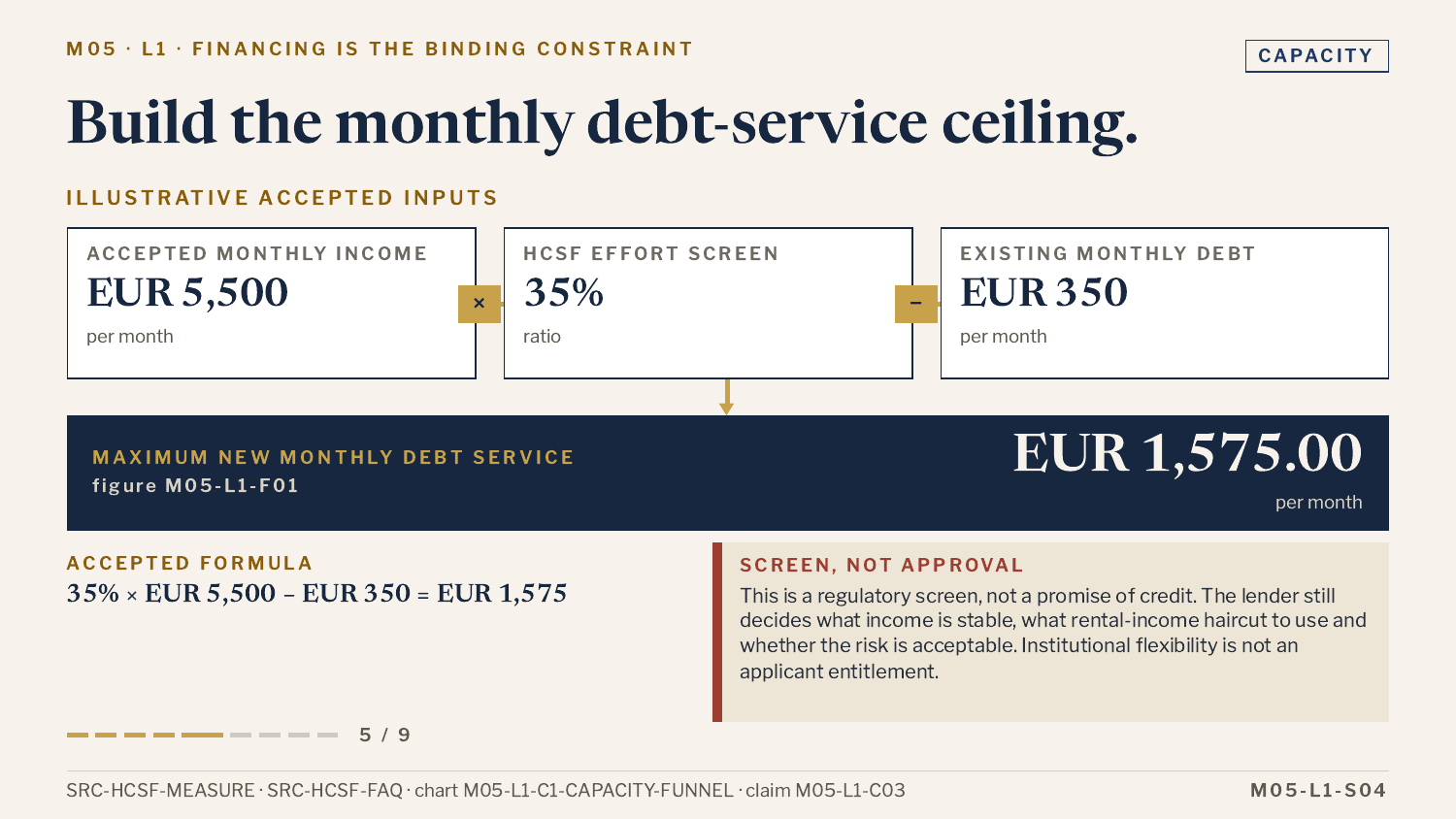
Model capacity under the two binding HCSF rules (35% max taux d'effort, insurance included; 25-yr term), check the all-in TAEG against the quarterly taux d'usure (Q3 2026 ≥20yr ceiling = 5.29%, in force 1 Jul–30 Sep 2026 — with a mandatory-refresh demonstration, since Q4 2026 supersedes it from 1 October), face the non-EU 50–70% LTV reality, and cut insurance cost via loi Lemoine.
Tool: Borrowing Capacity & Mortgage Calculator — max payment at 35%, max loan, implied price net of apport and the ~7–8% costs.
Place the four tax touchpoints in lifecycle order, work the unfurnished/furnished and micro/réel fork with correct 2026 thresholds, and — critically — get the social-charge rates right: fonciers and RE gains 17.2%, furnished BIC 18.6%. Plus IFI awareness (€1.3M trigger) and foreign-buyer reporting (FBAR/8938, UK Self Assessment).
Tool: Money & Tax Foundations — Four-Touchpoint Map, Regime-Fork Worksheet, Annual-Holding-Cost Estimator, Foreign-Buyer Reporting Checklist.
Localize the model to a real annonce, run copropriété due diligence (PV d'AG, charges, travaux votés, fonds travaux ALUR), and screen the two silent yield-killers — encadrement exposure (rent vs 120% loyer de référence) and DPE class — before you offer. Negotiate a compromis-ready offre using loi Carrez and priced defects as levers.
Tool: Deal Underwrite & Due-Diligence Kit — underwrite outputting gross and derived net, viewing/diagnostics red-flag grid, copropriété scorecard, yield-killer gate, offer brief.
The single most decision-critical and fastest-decaying module. Apply the LMNP/LMP test (CGI 155 IV), quantify the amortissement benefit during holding and its cost at exit under the 15-Feb-2025 recapture, and choose own-name vs SCI à l'IR vs SCI à l'IS on a holding-vs-exit trade-off — avoiding the trap that furnished letting forces an SCI into IS. Output a citation-backed, caveated at-signing memo with a sign-off line for your French fiscaliste/notaire.
Tool: The Vehicle & Regime Comparator — own name vs SCI IR vs SCI IS over holding + exit, with amortissement recapture, surtaxe, and the correct 17.2%/18.6% split; "holding-vs-exit break-even" included.
Model whether deal #2, #3, #N is reachable inside HCSF limits and the under-used 20% margin, choose a multi-SCI/IS structure, build a France team (notaire, courtier, chasseur, gestionnaire, expert-comptable), and run the cross-border layer: représentant fiscal (overhauled by Décret 2025-502), French non-resident banking and SIP filing, EUR/foreign-currency mismatch, AML source-of-funds.
Tool: Portfolio Scaling & HCSF Capacity Tracker — recomputes taux d'effort after each loan; foreign-income EUR conversion; cross-border compliance calendar.
Run the DPE gate first (G banned, F 2028, E 2034), choose and draft the right bail (nu 3yr/6yr vs meublé 1yr / student 9-month) with correct notice, congé and deposit rules, test encadrement exposure across the ~69 communes / 9 territories, compute the 120% cap, and price the 23 Nov 2026 expiry risk — then patch every constraint back into the deal model as a number.
Tool: Letting Compliance Checker — DPE let-or-not gate, lease-type selector, encadrement exposure tester + rent-cap calculator, deposit/notice tracker, constraint-to-model patch.
Underwrite STR honestly from ADR × occupancy × truly-available nights, apply the correct day cap (120 nights principal residence, reducible to 90 by commune; dedicated lets uncapped nationally but local change-of-use applies), choose classé vs non-classé micro-BIC, and compute the real net including CFE from year 2, the 18.6% social charge, and sale-day recapture — plus the 13-digit registration and syndic-ban check.
Tool: STR Underwriting & Compliance Model — day-cap input cell, seasonality split, micro-BIC selector, 18.6% line → gross and net yield; classé-vs-non-classé cost/benefit.
Model the exit and holding economics — the 22-year IR / 30-year social plus-value clock, the >€50,000 surtaxe, LMNP amortisation recapture, IFI above €1.3M — and assemble everything into one written go/no-go Decision Dossier, with the "refresh before you act" routine on the facts that move.
Tool: Exit & Decision Dossier — plus-value/surtaxe/recapture/IFI calculator + the cross-module dossier that says go or no-go for your situation.
Three things make this a category of one, and each is precisely where the rest of the field is weakest.
Every France-specific figure traces to the Current Facts Pack — primary law by Legifrance article/JORF ID, official secondary sources by name. Provisional items are flagged [NEEDS CONFIRMATION], not stated as gospel — and cleared when the law lands (e.g. the €83,600 2026 micro-BIC threshold, flagged until the Loi de finances 2026 enacted it). Competitors teach stale certainty; we teach current, sourced reality with the uncertainty marked.
No English-language competitor productises this. The 14 tools are the decision engine — they answer the exact commercial questions ("net yield after tax in this département," "LMNP vs LMP for my income," "SCI IR vs IS over an 8-year hold") that generic content can't, because the answer depends on your numbers.
French property tax and law are moving targets — the taux d'usure resets quarterly, social charges just split, rent control may lapse on 23 Nov 2026, and finance acts arrive every winter. The course is built to be refreshed, and the optional membership keeps the figures and tools current so you re-run, not re-learn.
A system to make your decisions — not a buyer's-agent service, and not for anyone who won't open a spreadsheet.
No invented testimonials, no fabricated student counts — the proof is the verified facts layer and the tools themselves.
.xlsx calculators you keepSell the transformation once per segment; charge recurring only for the thing that genuinely decays — the law, tax and market numbers, and the re-runnable tools.
For buying a home or second home to live in.
For yield, structure & scale decisions. Payment plan: 12 × €150 (value ~€2,900 in displaced professional fees) [VALIDATE].
Includes Year 1 membership · 30-day guarantee
For staying right after launch. Bundled free for Year 1 inside the flagship.
Against a €3,500-anchored "value" consultation, a buyer's agent charging 2–4% of purchase price (on a €400,000 buy, that's €8,000–€16,000), or a single avoidable mistake — an unmodelled amortisation recapture, a class-G unit you can't let, the wrong vehicle locked in at signing — a one-time €1,500 [VALIDATE] for a complete system plus working calculators is inexpensive insurance against six-figure errors.
Year 1 of the membership is bundled free into the flagship. The membership exists for one honest reason: the numbers decay. The taux d'usure resets every quarter, the micro-BIC threshold indexes, social charges shifted, and rent control may expire on 23 Nov 2026. When the figures move, you re-run your tools — you don't re-buy the course.
All prices are launch estimates pending live-launch validation [VALIDATE].
You shouldn't have to gamble to find out whether a system fits the way you think.
Go through the core, build the French Property Deal Model on an actual listing, and run it through the Vehicle & Regime Comparator. If it hasn't given you a clearer, better-informed go/no-go on a real French deal than anything else you've used, email us within 30 days for a full refund. We'd rather you keep the tools and the clarity than keep your money under false pretences.
The only thing we can't promise is a specific return — no honest educator can, and France's rules move. What we promise is that you'll be working from current, cited law and your own numbers, with the moving targets flagged, instead of advice that expired three reforms ago.
Yes — the status fork is built in from Module 1. You'll model the non-EU 50–70% LTV reality, the social-charge overlay (non-EU/EEA/Swiss non-residents now 18.6% on French rental income and gains from 1 Jan 2026; EU/EEA/Swiss-affiliated keep 7.5%), the représentant fiscal regime (Décret 2025-502), treaty relief, and US FBAR/8938 or UK Self Assessment reporting. US buyer? See the US Edition pre-release →
No. It's education. Every figure is dated and cited, and the structuring module ends with a memo carrying a sign-off line for a French fiscaliste or notaire. You leave able to ask the right questions and check the right numbers — not to skip professional advice.
The facts layer states the law and market as verified in mid-2026 (last re-verified 2 July 2026), pinned to Legifrance and official sources. Fast-decaying items are flagged — for example the quarterly taux d'usure (Q3 2026 figures expire 30 September) and the 23 Nov 2026 rent-control expiry — and provisional items are cleared once enacted (the €83,600 2026 micro-BIC threshold is now law, LF 2026). The membership keeps these refreshed.
The teaching is delivered as a self-paced video spine with workbooks, templates, and 14 working calculators. The substance is the verified law and the decision tools — that's where the value lives, and it's exactly what no competitor productises.
No French required — the course translates the annonce, the compromis, the diagnostics, and the tax terms. No prior French purchase needed; Module 1 starts from your goal.
It's the timely hook and it's taught precisely in Module 8: amortissement recaptured into the gain from 15 Feb 2025, but only amounts "admis en déduction" (not amortissements différés), pre-2025 depreciation included, managed student/senior residences excluded. LF 2026 (promulgated 19 Feb 2026) retained LMNP amortisation; the new "statut du bailleur privé" (dispositif Jeanbrun) is now enacted (LF 2026 art. 47 — an unfurnished-lane amortisation regime with its own caps and recapture), and the art. 53 non-resident LMP-test change is covered too.
Evergreen and self-paced — start today, go at your pace, keep the tools.
The flagship still serves you — it includes the Relocation/Visas (M10) and Region/Renovation/Second-Home Cost (M11) modules and their tools. If you only want the lifestyle path, the "Buy Your French Home" tier (€600 [VALIDATE]) is the leaner fit.
…and a buyer's agent who has no reason to teach you the math. Get the only kept-current, calculator-driven system built on verified 2026 French law — and walk out with a written go/no-go dossier for your own deal.
→ Build a French Portfolio — €1,500 [VALIDATE], one-time.
Includes all 14 modules, all 14 tools, the 2026 facts layer, and Year 1 of "French Property Current" free.
Education, not advice. Figures dated to June 2026 and cited to Legifrance/official sources; fast-moving items flagged for re-verification before you act.